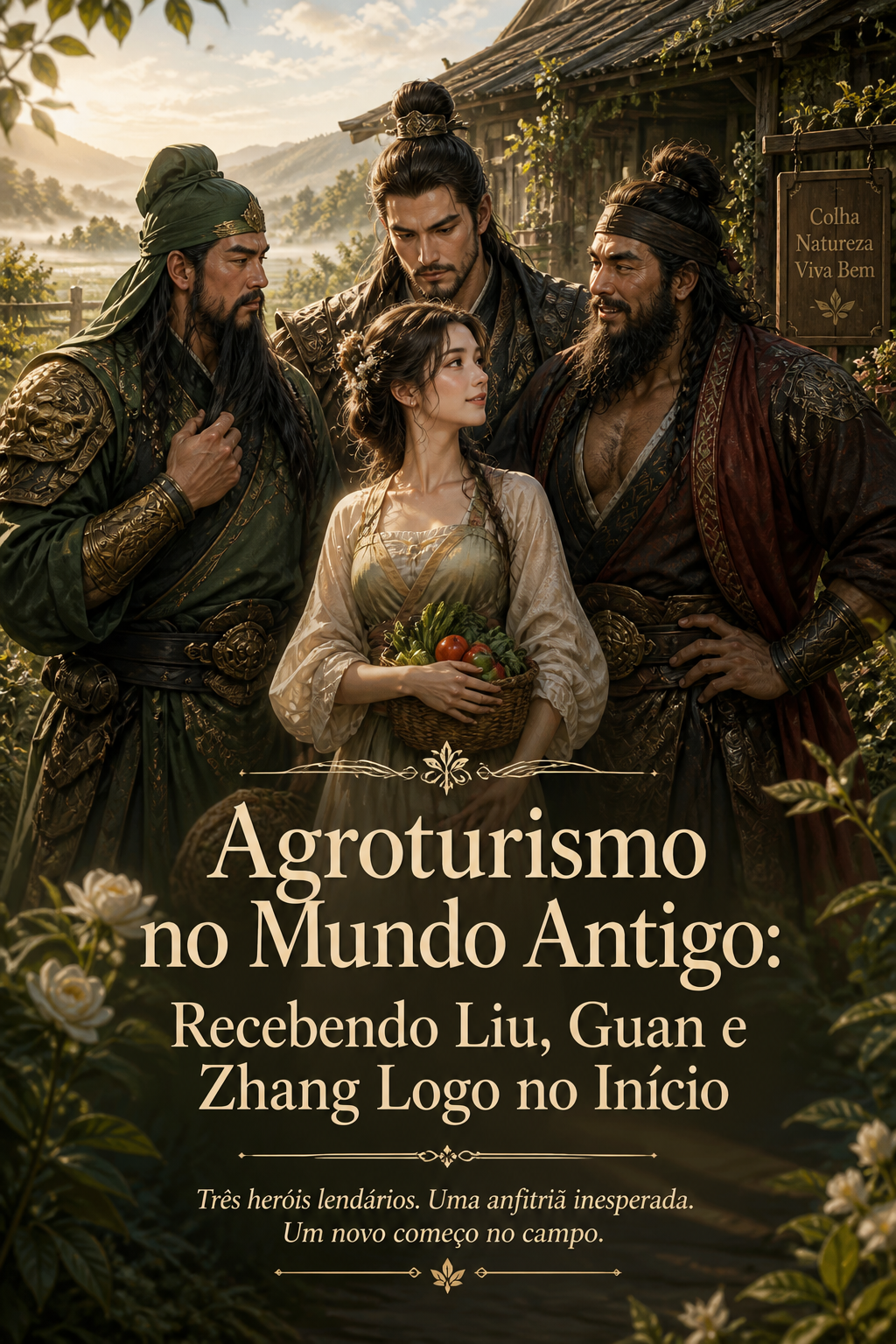
Agroturismo no Mundo Antigo: Recebendo Liu, Guan e Zhang Logo no Início
Ao administrar uma pousada rural, Zhang Bo percebeu um problema: parecia que sua pousada havia se tornado uma ponte entre várias dinastias. Uma série de figuras históricas famosas estavam reunidas ali
In the early morning, Qingxing Village was gently touched by the first rays of dawn. Soft light filtered through a delicate mist, draping the entire village in a faint golden veil. The calls of roosters and barking of dogs rang out in succession, shattering the stillness of the night, yet together they formed a perfect rural morning symphony.
With a creak, the door of a farmhouse at the far end of Qingxing Village swung open and a young man stepped outside. His name was Zhang Bo, the owner of this farmhouse inn.
Stepping outside, Zhang Bo took a deep breath, savoring the earthy fragrance that lingered in the air, his expression subtly shifting. Once, he too had been a city dweller, slogging through a life that was nearly round-the-clock work. Eventually, he made his decision: he was done with that grind.
Fortunately, he had never transferred his household registration to the city. The house his grandfather left him still stood, and, as luck would have it, in recent years tourism in Qingxing Village had flourished. So, Zhang Bo returned home and, like the other villagers, opened a guesthouse.
And today was its opening day.
Just as Zhang Bo was about to stretch his limbs, he suddenly spotted a child of about ten, dressed in ancient attire, dozing in the corner by the wall of his inn.
He quickly strode over, crouched down, and spoke softly to the boy.
“Little Ju, wake up. Why did you come here without telling me?”
The child’s name was Liu Ju. His name, far from obscure, was illustrious in history—most notably as the legitimate